
When we talk about impact investing, we usually imagine foundations being the ones providing the capital. But after many years of accompanying organizations on this journey, I have found that they can play three very different roles. And that many already play some of these roles without naming them.
Impact investing seeks to ensure that capital generates measurable social and environmental changes in addition to economic returns. For this to work, someone needs to be willing to finance the development of solutions; someone needs to provide that funding; and someone needs to connect the two. Foundations and third-sector organizations can be on any of these three sides.
When the foundation provides capital
This is the most well-known type of role. A foundation can allocate part of its resources to invest in companies and projects that solve social or environmental problems, either through soft loans, equity investments, or co-investments with other entities.
And it’s not a choice between investing or giving. Donations can act as catalytic capital that takes on the first risks, and investing can multiply the scope of what the foundation already does. Both tools, when combined well, serve the mission better.
And this is exactly what we do at the Impact Foundations Fund; more than 45 foundations co-invest in early-stage social enterprises, sharing risks, knowledge, and learnings.
When the foundation needs capital
Many non-profit social entities carry out their own economic activity. For example, insertion companies, special employment centers, services that generate their own income, or projects that could grow if they had more than just subsidies. For them, impact investing opens up new funding channels such as loans, repayable financing, or capital that allows them to scale what already works.
Taking that step requires other tools such as a clear sustainability model, the ability to measure and communicate the impact, and the ability to engage in dialogue with investors. These are skills that can be learned.
When the foundation connects
There is a third role of foundations that is often invisible and very necessary: that of the intermediary foundation. Foundations know the territories, the collectives and the problems they work with like no one else. That closeness makes them natural allies in identifying projects, accompanying social entrepreneurs, offering technical assistance, promoting collective investment vehicles or bridging the gap between those who have capital and those who have solutions.
Without intermediaries that generate trust, capital and impact initiatives are hard to find.
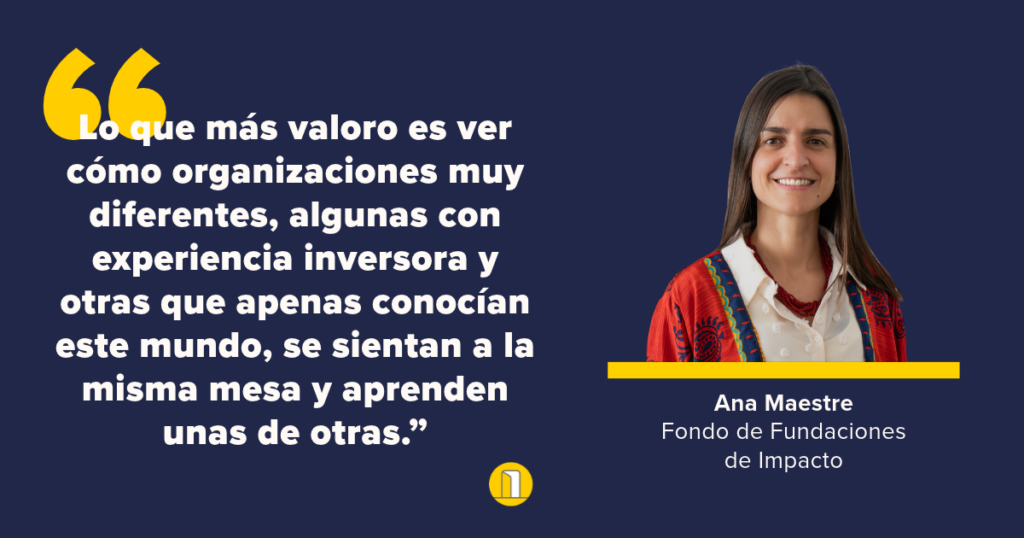
That is why, at the Impact Foundations Fund, we continue to invest in training. More than 70 organizations have already participated in our programs, and What I value most is seeing how very different organizations, some with investment experience and others that knew very little about this world, sit down at the same table and learn from each other.
From February 4 to March 18, 2027 We will celebrate VIII edition of Impact Investment Training for Foundations, open to foundations and third-sector entities. A space to understand how the ecosystem works, learn about real cases, resolve doubts, and discover the role each entity can play.
I want to especially encourage those who have ever considered taking this step and have been putting it off because of a lack of time, knowledge, or confidence.
Perhaps not all of us will end up filling all three roles. But we should all know what our role is.
